| Nepenthes diabolica |
|---|
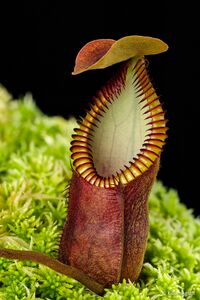 CAPTION |
| Genus | Nepenthes |
|---|
| Species | Diabolica |
|---|
| Publishing Authority | Unknown |
|---|
| Year Described | 2004 |
|---|
| Distribution | single mountain in Central Sulawesi |
|---|
| Altitudinal Distribution (m) | 2,200–2,300 m |
|---|
| IUCN Conservation Status | Unknown |
|---|
Species Summary
Description
Nepenthes diabolica, prior known under the ( “RED HAIRY HAMATA” / “RHH” ) Label
Discovered in 2004, and long known as “Red Hairy Hamata” (“RHH”), Related species, N. maryae with different uppers, similar lowers
The specific epithet "diabolica" is Latin for "diabolical" or "devilish" and refers to both the typical red coloration of the lower pitchers and their greatly enlarged peristome teeth
Traits and Characteristics
Characterized by an exceptionally toothy peristome and conspicuous, woolly pitcher indumentum.
Morphologically it is closest to N. hamata, the only other species from Sulawesi with a similarly elaborated peristome. though in breeding Diabolica traits seem more dominant in expression, typically N. hamata in other crosses would be dominant , which is an interesting behavioral trait for gene expression.
Habitat and Growth
Known only from a single mountain in Central Sulawesi, where it occurs at c. 2,200–2,300 m above sea level.
N. diabolica is one of the more sensitive species to grow in cultivation , it is easily stressed and sensitive to temperature fluctuations , more so if deficient in specific nutrients amplify this characteristic exponentially.
Specimens seem to be more tolerant of conditions if Iron, Magnesium and Boron is present for stabilization for growing out of its optimal temperature range.
Night drops are crucial for proper metabolic functions
Horticultural History
The species was known to botanists as early as 2005, Discovered by Ch'ien Lee and was stated to be anew form of N. hamata with an exceptionally dense indumentum. For years afterwards the taxon was informally known in cultivation as N. hamata "red hairy" or simply "red hairy hamata". Later it became known as Nepenthes ronchinii, in honor of Italian botanist Luigi Ronchini, before the taxon was formally described as Nepenthes diabolica in 2020.
Status in the Wild
Horticultural Grex Database
Template for Grex or Individual Plant Page: Nepenthes species
North and South American Grex Information
Nursery Name
| Release Nursery
|
Grex
|
Type
|
Description
|
Seed Parent (Female)
|
Pollent Parent (Male)
|
Release Date
|
Collaborators
|
|
|
|
|
|
|
|
|
|
|
|
|
|
|
|
|
|
|
|
|
|
|
|
|
|
|
|
|
|
|
|
|
|
|
|
|
|
|
|
|
|
|
|
|
|
Other Nurseries / Private Growers
| Release Nursery
|
Grex
|
Type
|
Description
|
Seed Parent (Female)
|
Pollen Parent (Male)
|
Release Date
|
Collaborators
|
| Jerimiah Harris
|
|
|
|
|
|
|
|
| Florae Colab
|
|
|
|
|
|
|
|
|
|
|
|
|
|
|
|
|
|
|
|
|
|
|
|
|
|
Asian Grex Information
Nursery Name
| Release Nursery
|
Grex
|
Type
|
Description
|
Seed Parent (Female)
|
Pollent Parent (Male)
|
Release Date
|
Collaborators
|
|
|
|
|
|
|
|
|
|
|
|
|
|
|
|
|
|
|
|
|
|
|
|
|
|
|
|
|
|
|
|
|
|
|
|
|
|
|
|
|
|
|
|
|
|
Other Nurseries / Private Growers
| Release Nursery
|
Grex
|
Type
|
Description
|
Seed Parent (Female)
|
Pollen Parent (Male)
|
Release Date
|
Collaborators
|
| Borneo Exotics
|
BE-4015
|
|
Overly Sensitive in comparison with other clones, can be slow to grow, spontaneous death is known
|
|
|
|
|
|
|
|
|
|
|
|
|
|
|
|
|
|
|
|
|
|
|
Australian & Oceania Grex Information
Nursery Name
| Release Nursery
|
Grex
|
Type
|
Description
|
Seed Parent (Female)
|
Pollent Parent (Male)
|
Release Date
|
Collaborators
|
|
|
|
|
|
|
|
|
|
|
|
|
|
|
|
|
|
|
|
|
|
|
|
|
|
|
|
|
|
|
|
|
|
|
|
|
|
|
|
|
|
|
|
|
|
Other Nurseries / Private Growers
| Release Nursery
|
Grex
|
Type
|
Description
|
Seed Parent (Female)
|
Pollen Parent (Male)
|
Release Date
|
Collaborators
|
|
|
|
|
|
|
|
|
|
|
|
|
|
|
|
|
|
|
|
|
|
|
|
|
|
|
|
European Grex Information
Wistuba
| Release Nursery
|
Grex
|
Type
|
Description
|
Seed Parent (Female)
|
Pollent Parent (Male)
|
Release Date
|
Collaborators
|
| Wistuba
|
AW 1
|
?
|
more sensitive clone, likes constant humidity, Typical typeform
|
?
|
?
|
|
|
| Wistuba
|
AW 2
|
?
|
|
|
|
|
|
| Wistuba
|
AW 3
|
?
|
|
?
|
?
|
|
|
| Wistuba
|
AW 4
|
F
|
denotes stress with malformed leaves, repot can easily stress, Typical typeform
|
?
|
?
|
|
|
| Wistuba
|
AW 5
|
M
|
|
?
|
?
|
|
|
| Wistuba
|
AW 6
|
?
|
|
|
|
|
|
| Wistuba
|
AW 7
|
?
|
|
?
|
?
|
|
|
| Wistuba
|
AW 13
|
?
|
circular shaped opening , darker red , dark teeth
|
?
|
?
|
|
|
| Wistuba
|
AW 14
|
F
|
the easiest of the AW grex to establish and grow, yellows and reds, exaggerated teeth
|
?
|
?
|
|
|
Other Nurseries / Private Growers
| Release Nursery
|
Grex
|
Type
|
Description
|
Seed Parent (Female)
|
Pollen Parent (Male)
|
Release Date
|
Collaborators
|
| BCP
|
|
|
|
|
|
|
|
|
|
|
|
|
|
|
|
|
|
|
|
|
|
|
|
|
|
African Grex Information
Nursery Name
| Release Nursery
|
Grex
|
Type
|
Description
|
Seed Parent (Female)
|
Pollent Parent (Male)
|
Release Date
|
Collaborators
|
|
|
|
|
|
|
|
|
|
|
|
|
|
|
|
|
|
|
|
|
|
|
|
|
|
|
|
|
|
|
|
|
|
|
|
|
|
|
|
|
|
|
|
|
|
Other Nurseries / Private Growers
| Release Nursery
|
Grex
|
Type
|
Description
|
Seed Parent (Female)
|
Pollen Parent (Male)
|
Release Date
|
Collaborators
|
|
|
|
|
|
|
|
|
|
|
|
|
|
|
|
|
|
|
|
|
|
|
|
|
|
|
|
Wild Collected
| Release Nursery
|
Grex/Name
|
Type
|
Description
|
Seed Parent (Female)
|
Pollen Parent (Male)
|
Release Date
|
Collaborators
|
|
|
|
|
|
|
|
|
|
|
|
|
|
|
|
|
|
|
|
|
|
|
|
|
|
|
|
|
|
|
|
|
|
|
|
|
|
|
|
|
|
|
|
|
|
|
|
|
|
|
|
|
|
|
|
|
|
|
|
|
|
|
|
|
|
|
|
|
|
|
|
|
|
|
|
|
|
|
|
|
|
|
|
|
|
|
|
|
|
|
Individual Plants
| Specific Plant
|
Grex
|
Introduced By
|
Gender
|
|
|
|
|
|
|
|
|
|
|
|
|
|
|
|
|
|
|
|
|
|
|
|
|
|
|
|
|
|
|
|
|
|
|
|
|
|
|
|
|
|
|
|
|
|
|
|
|
|
|
|
|
|
|
|
|
|
|
|
|
|
|
|
|
|
|
|
|
|
|
|
|
|
|
|
|
|
|
|
|
|
|
|
|
|
|
|
|
|
|
|
|
|
|
|
|
|
|
|
|
|
|
|
|
|
|
|
|
|
|
|
|
|
|
|
|
|
|
|
|
|
|
|
|
|
|
|
|
|
|
Site Type Locations
References

